Cloth state changes with every contact.
Self-contact, friction, wrinkles, and occlusion make cloth difficult to model and leave a single end-to-end controller with a long, fragile horizon.
A real-robot cloth-manipulation system that uses separate ACT policies to flatten and fold a towel. An interpretable RGB-D terminal classifier decides when the towel is ready to switch from preparation to folding.
Robot Learning
Spring–Summer 2026
Robotics engineer
ROS2, LeRobot, ACT, RGB-D
Self-contact, friction, wrinkles, and occlusion make cloth difficult to model and leave a single end-to-end controller with a long, fragile horizon.
The simulation establishes a controlled folding baseline. On hardware, separate ACT policies learn flattening and folding from demonstrations, while TTCC selects the correct policy from geometric RGB-D measurements.
A 6-DoF OpenManipulator-Y performs the task using a wrist-mounted RealSense D405 and an external D415 RGB-D camera. Leader–follower teleoperation records demonstrations as LeRobot episodes for ACT training.

The wrist camera and robot state feed the learned policies, while the external RGB-D camera independently measures whether the towel is ready for the fold. ROS2 services connect perception, policy inference, and trajectory execution.
Leader–follower teleoperation records wrist images, follower joint states, and leader trajectories as LeRobot observation–action episodes. Each policy learns one coherent skill, avoiding the ambiguity of asking one network to both prepare and fold the towel.
An ACT policy reduces wrinkles and pulls the towel toward a rectangular, foldable configuration.
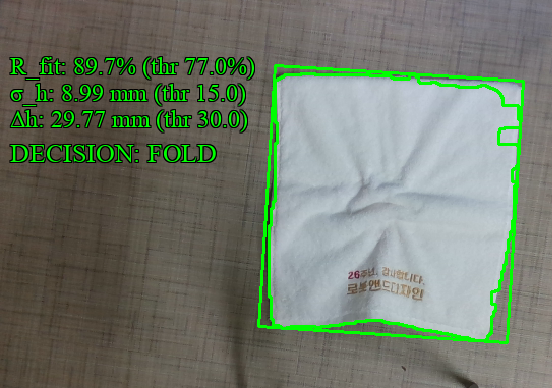
An interpretable classifier checks rectangularity and height variation, then emits FLATTEN or FOLD.
A second ACT policy executes the half-fold only after the towel reaches a suitable terminal state.
The system separates data collection, training, inference, and visual policy switching into testable ROS2 components.
The leader arm commands the follower while the system synchronizes wrist images, follower joint states, leader actions, and episode-control events into LeRobot-format trajectories.
The flattening model uses 60 episodes including DAgger corrections; the folding model uses 30 focused episodes. Each transformer predicts a short action chunk instead of a single joint command.
inference_server loads the selected checkpoint and returns action chunks. kkm_control_client requests actions and publishes the resulting robot trajectories.
realsense_towel_metrics estimates the tabletop, segments the towel, computes geometric metrics, and publishes /towel/decision to keep flattening or hand control to the folding policy.
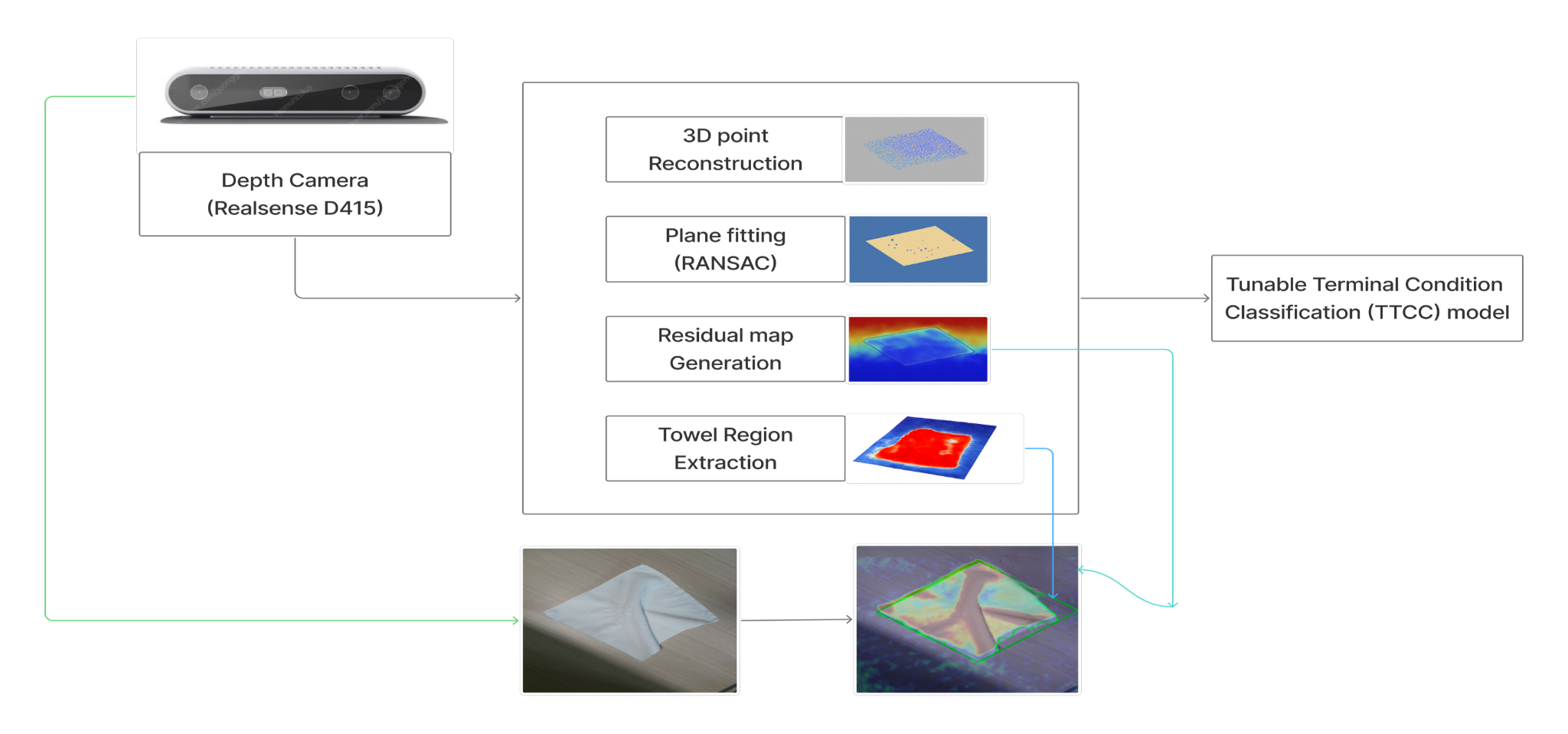
TTCC measures rectangularity fit Rfit, residual-height standard deviation σh, and robust height range Δh. Thresholds can be tightened for precise folding or relaxed in noisier environments.
FOLD if Rfit ≥ τrect
and σh ≤ τstd
and Δh ≤ τrangeAutonomous TTCC switching reached 80.0% full-task success, compared with 63.3% using manual transition timing. The result isolates policy orchestration—not only individual policy accuracy—as a central design problem.
76.7%
93.3%
63.3%
80.0%
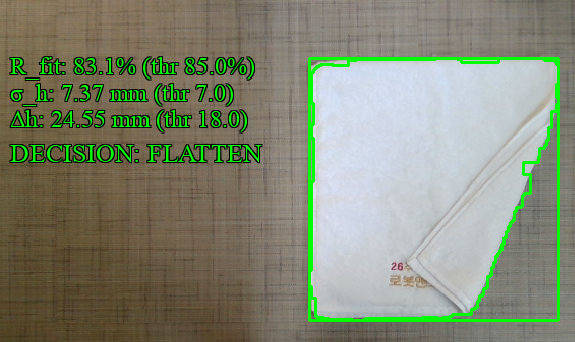
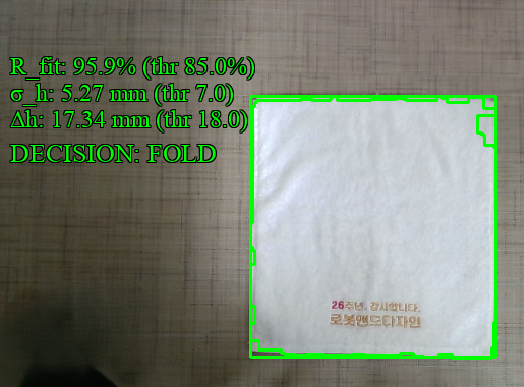
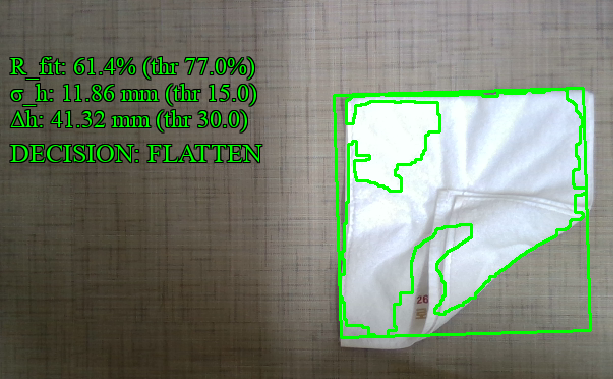
These rollouts show the OpenManipulator-Y executing learned cloth-manipulation actions. The first-stage policy prepares the towel; once TTCC detects a sufficiently flat, rectangular state, control passes to the folding policy.
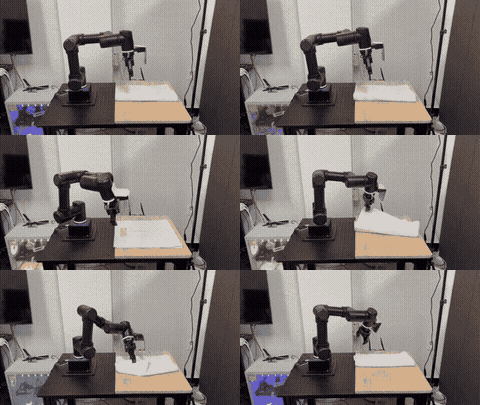
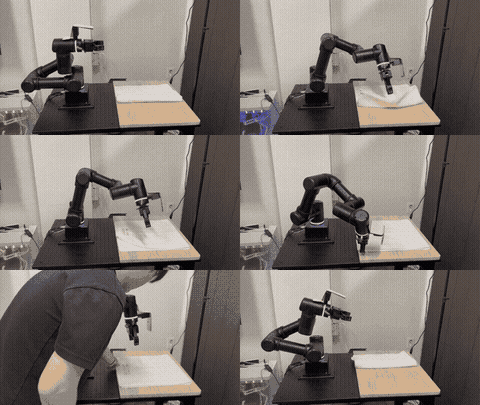
The learned policies handle varied demonstrated towel states, but unseen materials, sizes, severe occlusion, and out-of-distribution grasps remain open problems.
Expand DAgger collection around failure states, randomize cloth properties and camera pose, and learn recovery behaviors while retaining TTCC as an interpretable safety gate.
Persistent agent memory for robot experiment debugging and future data collection.